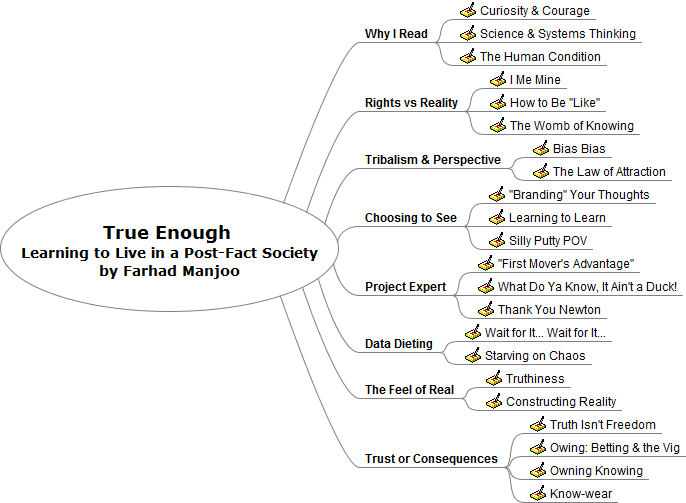


As far back as I can remember I have always wanted to know the world. As laudable as this sounds, the pursuit of knowledge can be confounding and painful. It take a modicum of courage expose one's self to the dissonance of discovery.
Somehow the American dream, having the right to act independently i.e. to progress one's self, transmuted into a right to hold and act on beliefs in conflict with fact. "I am the boss of me!" is the battle cry with a consequence of distorting what it means to "know" something.
Not only do we come to accept our thoughts as a form of reality, we build stories around those thoughts in support of the overall scheme.
Whom ever gets to present their "detailed" perspective of an event provides the ongoing basis for interpretation. This "explaination" also creates the touchstone for conflicting views and, in essence, adds to its substantiation.
Form can be a scheme of entrapment, legitimizing content by the context of delivery. Our assumptions of the "look & feel" of an expert afford our attention and acceptance of information. Once we "accept" a "fact" we are inclined to support and defend it, but the messenger is not the message!
Memes may sustain themselves due to their productive nature. They may also be sustained because they have social binding value, even if they are not factual or pragmatic. This inertia is both productive in sustaining knowledge in a social group but counter productive when the meme is untrue or prejudicial to human rights.
Information gathering may be active or passive. When expectations of active intervention are low then hope and passive "waiting" strategies tend to be used. When environments of appear to provide "streams" of information which have a high cognitive cost to consume and interpret there is a tendency to acquire an aggregating interpreter that becomes the legitimized "trusted" source.
The number of sources and immense volume of information overwhelm the consumer. This becomes and equalizing (and dumbing) force which causes structural changes in the delivery of media. Consumers become selectively similar and "simple" in their information consumption habits as media reciprocates to satisfy markets.
Consumers exhibit satisficing behavior, accepting a minimum of information that can be rationalized as true. Their indoctrinated perceptions and their "right" to reality allow them to select and rationalize an interpretation with little or no responsibility to challenge sources or facts.
The world we come to perceive includes a framework of ideology in sourcing channels and content. Those channels are accepted as legitimate, in part, because they have been legitimized through indoctrination and assimilation. The biases of association or likeness allows for the structuring of the individual's reality.
Knowledge is of no use unless it informs action. When there appears to be risk in the exchange of knowledge then the flow of information and its potential are throttled if not thwarted. The level of trust in and across social groups affects progress and predicts the quality of life.
Sharing information and knowledge is risky but it also has its rewards. As knowledge spreads and the potential for creative expression and interactions grow, the potential for productive actions rises. The initial cost of conveying and the anxiety bound to risk are part of "vig" you pay to play the game of growing societal progress.
As we "share" our knowledge we are also putting those accepting and acting on our information at risk. An on going question for any would be "world advisor" (which is most people opening their moths!) is: "Are you being responsible for your knowledge?" "Auditor emptor" (listener beware) may be a good attitude for your own consumption but is a poor ethic for sharing.